PORTFOLIO > PHYSICAL DESIGNS

CONVERSATION CORNER

OVERVIEW

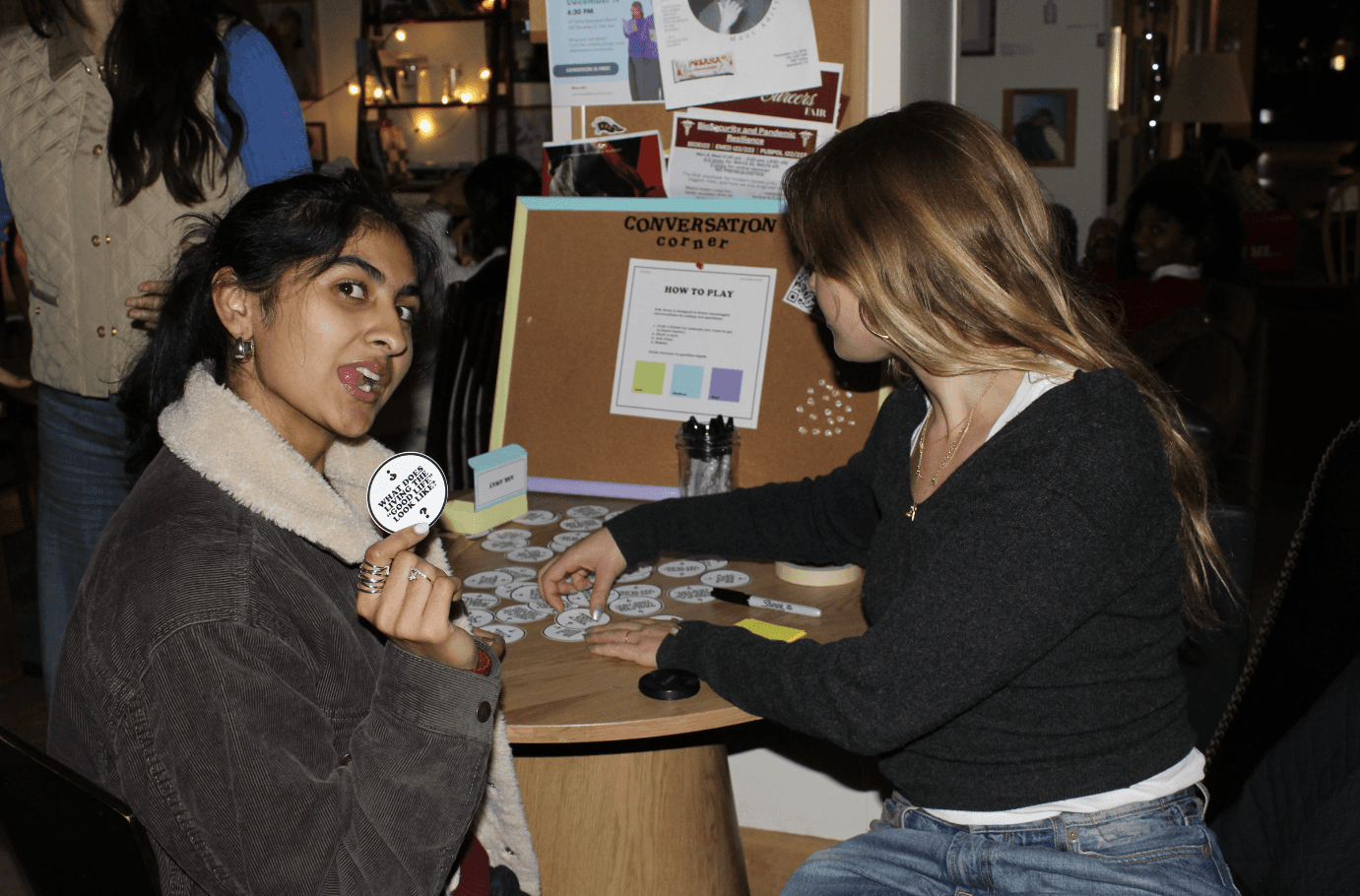
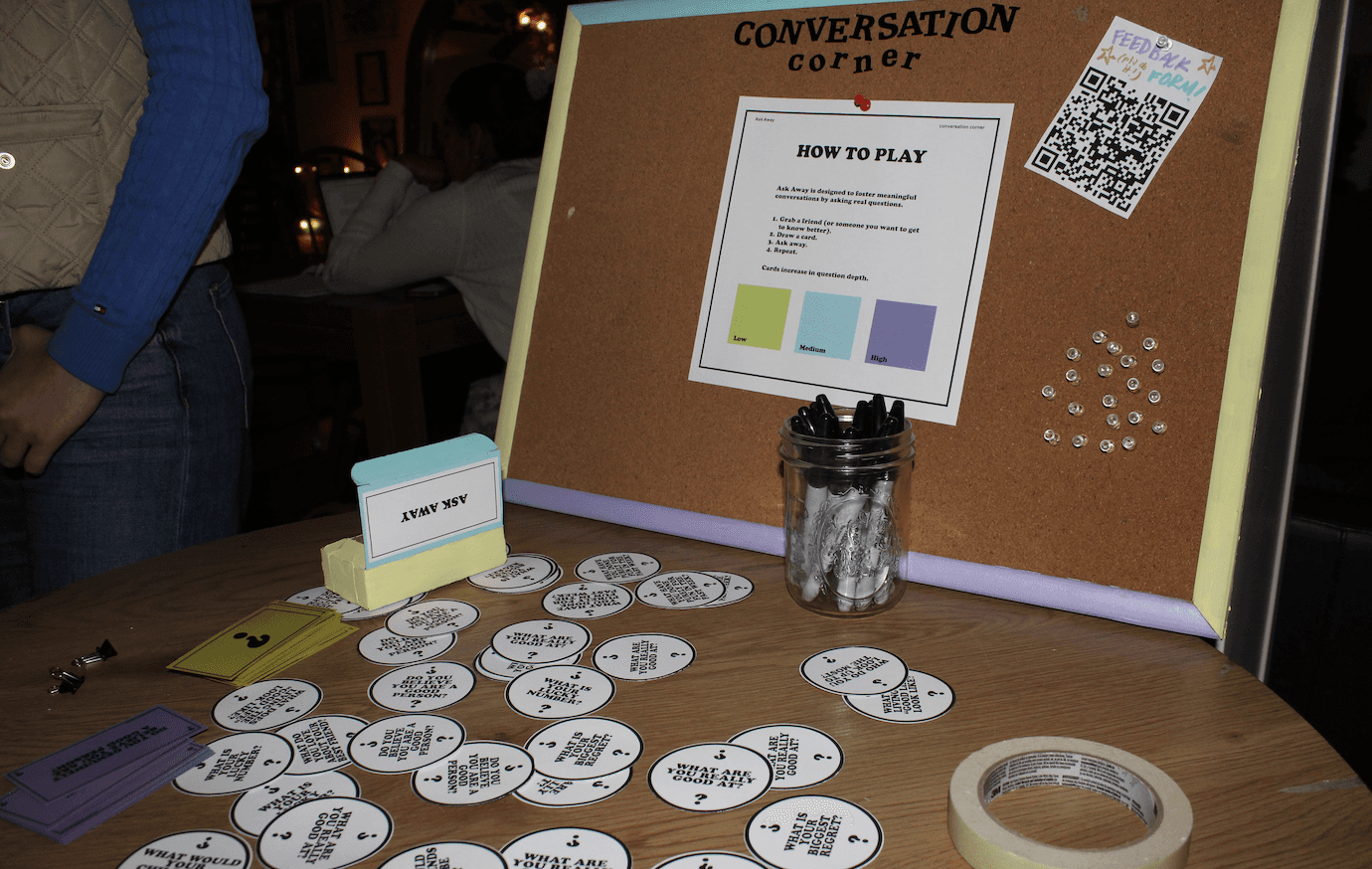
The Conversation Corner is a physical installation at Stanford’s student-run coffee shop, “On Call.” It is a cozy seating area with a table featuring the specifically designed card game “Ask Away!” which includes conversation prompts, ultimately inciting meaningful conversation among students in an optional, low-pressure environment.
Nationwide, adolescents have reported increased feelings of loneliness and disconnection—a phenomenon similarly reported among Stanford students. Students report feeling a lack of belonging, meaningful connection, and community. Broadly, our goal was to design a product or experience that built meaningful connections and community.

Prompting meaningful conversations among Stanford students through a designed card game containing conversation prompts at varying depths.

Encouraging student gatherings and lively conversation through spatial redesigns and the coffee shop's interior design.

Role: Lead Designer

Tools: Adobe Illustrator, Figma

Team Members: Linden Hansen (assignment project partner!)

Project Length: Three weeks

Methods: User Interviews, User Research, Low/High Fidelity Wireframing

EXPLORATION & DISCOVERY

COMPETITIVE ANALYSIS:

To begin, I identified a program that successfully fosters community on campus: Stanford’s Structured Liberal Education (SLE). This is a year-long intensive residential humanities program: students live in the same dorm and take a humanities course that accounts for about half of their total workload, in which they read (roughly) a book every week and spend 8-9 hours per week in lectures or discussions centered on this text. This program has existed for 50+ years and is lauded for its close-knit community of students and faculty members. We wanted to examine SLE to understand how it works from an administrative perspective, its impacts on the students’ attitudes, and ultimately determine the actual root of SLE’s community-building nature.


INTERVIEWS:

Given our short time frame, we wanted to pursue user research methods that would yield rich information quickly. Therefore, we relied on interviews, as the amount of information one could gain in a 30-minute interview was immense, and we did not have the time to distribute and collect extensive survey data. Furthermore, “community” is a highly personal topic and extremely difficult to quantify. Thus, qualitative research with interviews seemed more useful than surveys.

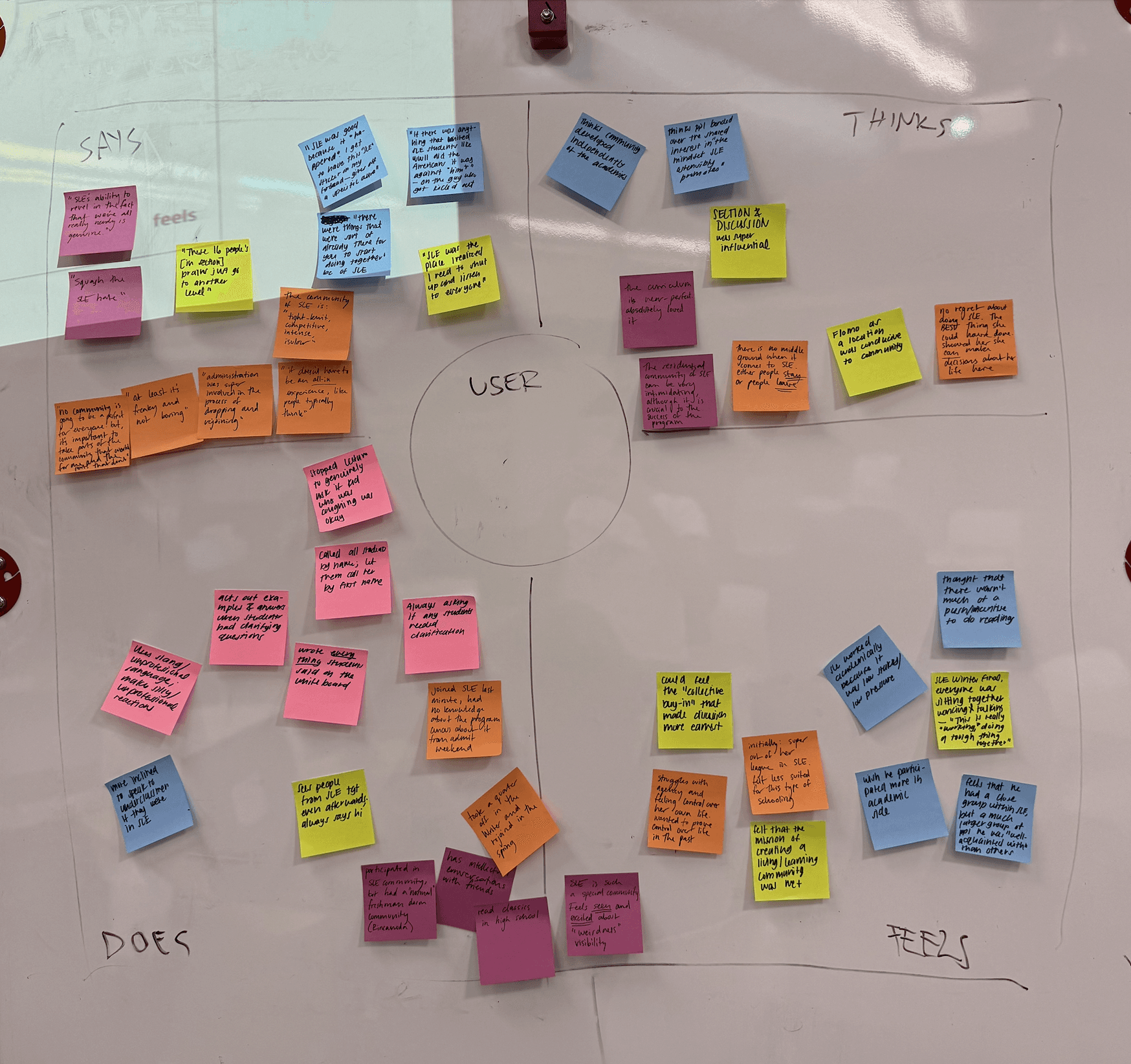
We interviewed five active SLE students, five SLE alumni, five students who did the university-required humanities program COLLEGE (SLE students are exempt from this, so this was to understand why SLE historically has fostered community while COLLEGE notoriously does not), and the administrative director of SLE.

INSIGHTS # 1:

Every SLE-associated student and administrator emphasized the importance of the collective grappling with difficult questions. The director discussed how the crux of human thought and contemplation involves considering a series of complex moral and ethical questions: what SLE does is place the burden on students to answer these questions for themselves now, rather than later in life. Multiple students said their conversations were meaningful due to the group dynamics, where “these collective sixteen minds just go to another level.” In essence, working through complex tasks or topics together seems to foster a shared sense of purpose, fostering community among students.

INSIGHTS # 3

More broadly, 87% students reported that in general conversation, it was often difficult to stray from the typical discussion points of classes, social scenes, and extracurricular activities. Many spoke about the difficulty of raising more difficult topics in conversation, stating that they don’t know if the desire to deepen the conversation is reciprocated. If SLE students mentioned this, I followed up by asking if this applied to SLE students outside of discussion times. Most reported that it didn’t, because there was an inherent shared desire for meaningful conversation (see the “optionality” aspect) and a pre-existing task to work on, as they all had the same weekly workload. One student even mentioned that during new student orientation, SLE bonding begins before school even starts, as everyone is required to read a few books, creating a shared task and experience for students to do together.

INSIGHTS # 2:

Secondly, 80% of SLE students referenced the “buy-in” to SLE; that is, the optionality of SLE. To participate in SLE, one must apply in advance for housing assignments. Students reported that knowing others chose to be there and to have these intense conversations made them feel more comfortable and open to sharing their thoughts. Alternatively, COLLEGE students reported feeling hesitant to explore the text and their thoughts more deeply because they didn’t want to seem overeager compared to their more “nonchalant” classmates. (This word, nonchalant, was thrown around a lot. It appears to be a very desirable trait among university students right now.) The optionality of SLE created “a sense of collective earnestness” that encouraged meaningful and genuine discussion.

IDEATION

With this information, we aimed to create an experience that includes the three key traits we identified above: a shared, but optional, task that prompts meaningful conversation. How might we leverage transformative conversations and encourage grappling with hard questions to build community?

In our experience design process, we ideated about 30+ ideas that ranged in terms of uniqueness, feasibility, and optionality.

We initially considered starting a book club where students could sign up, be randomly assigned to a group of about 5 other students, and, over the course of the month, receive readings and conversation prompts from a newsletter we’d design. However, when we spoke to students about this idea, they commented that it would likely feel like another task on top of their heavy course load and would lead to a lack of traction and genuine engagement.

For the spatial aspect of the experience, we did a little more research into existing solutions on campus and found the Yost Conversation Tables. Yost is a dining hall in a dorm that emphasizes global connections. One of their unique features is their language-learning tables, where each table has a designated language and day, during which the only language spoken at that table is the foreign language they’ve selected (most commonly Mandarin and Spanish). This has the key traits of optionality and a shared task, but often leads to relatively shallow conversations, as the purpose is to practice speaking a language rather than to facilitate meaningful discussion. Still, the Yost dining tables were a good starting point.

Side note: We noticed that the Yost conversation tables were circular, as were the tables in the SLE-associated dining hall, which multiple students said were more conducive to conversation than the rectangular tables at the larger, more general dining halls. Not a priority of ours, but a repeated observation.

For the task that incited meaningful conversation, we researched various methods of conversation prompting (“32 Questions to Fall in Love” articles, etc.). We were particularly captivated by the card game “We Are Not Really Strangers.” This game contains cards with conversation prompts of varying depths, and the game is designed so that you begin at lighter topics and then delve quite deep. We felt that a card game had the physical task element of SLE readings and an element of randomness. As mentioned above, many students reported anxiety of being the first in a conversation to propose a deeper topic, and just leaving a list of conversation prompts to choose from would not eliminate this anxiety, as one person would still have to be the first to suggest a deeper prompt. Having a physical deck of cards to select a prompt from helped eliminate this anxiety. 

To test these conversation prompts, we created a list of about 100 prompts and tested them with various students and friends we had (I tested them in my physics office hours, while my partner tested them at her sorority). We asked them to report which prompts they liked and disliked, then narrowed our list down to 60 prompts of varying depth.

FINAL DESIGN & FEEDBACK

We decided to implement a similar concept as the Yost dining halls in a student-run cafe, On Call. As Yost does, there needed to be a sign indicating the table's specificity and purpose, along with a shared task that prompted meaningful conversation.

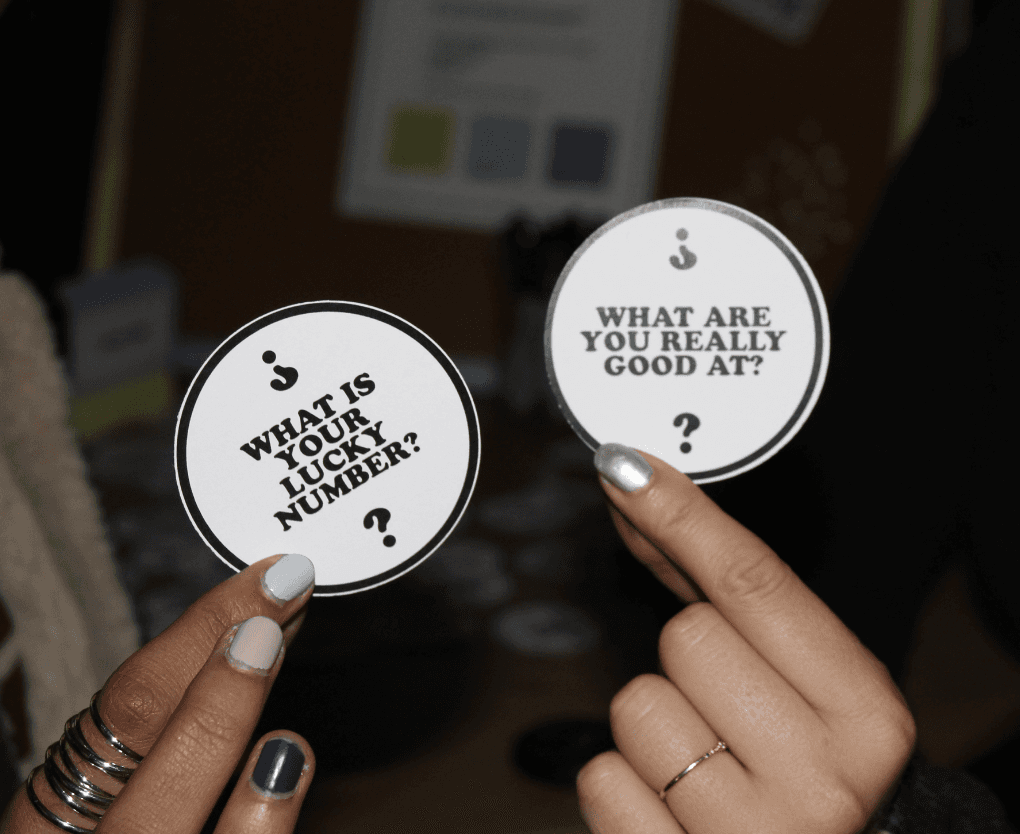
The physical design of the cards ended up being quite simple: we used three different colors to describe the varying depth of the prompts, and had a simple design of a black outline, a stylized question mark, and the question written in Cooper Black. This same design can be easily applied to different shapes and mediums, allowing us to create stickers and other merchandise with these prompts and branding for our launch day. We then laminated the cards to make them sturdier and last longer than simple cardstock, painted a box with the same color palette as the cards, and included the instructions on the inside.

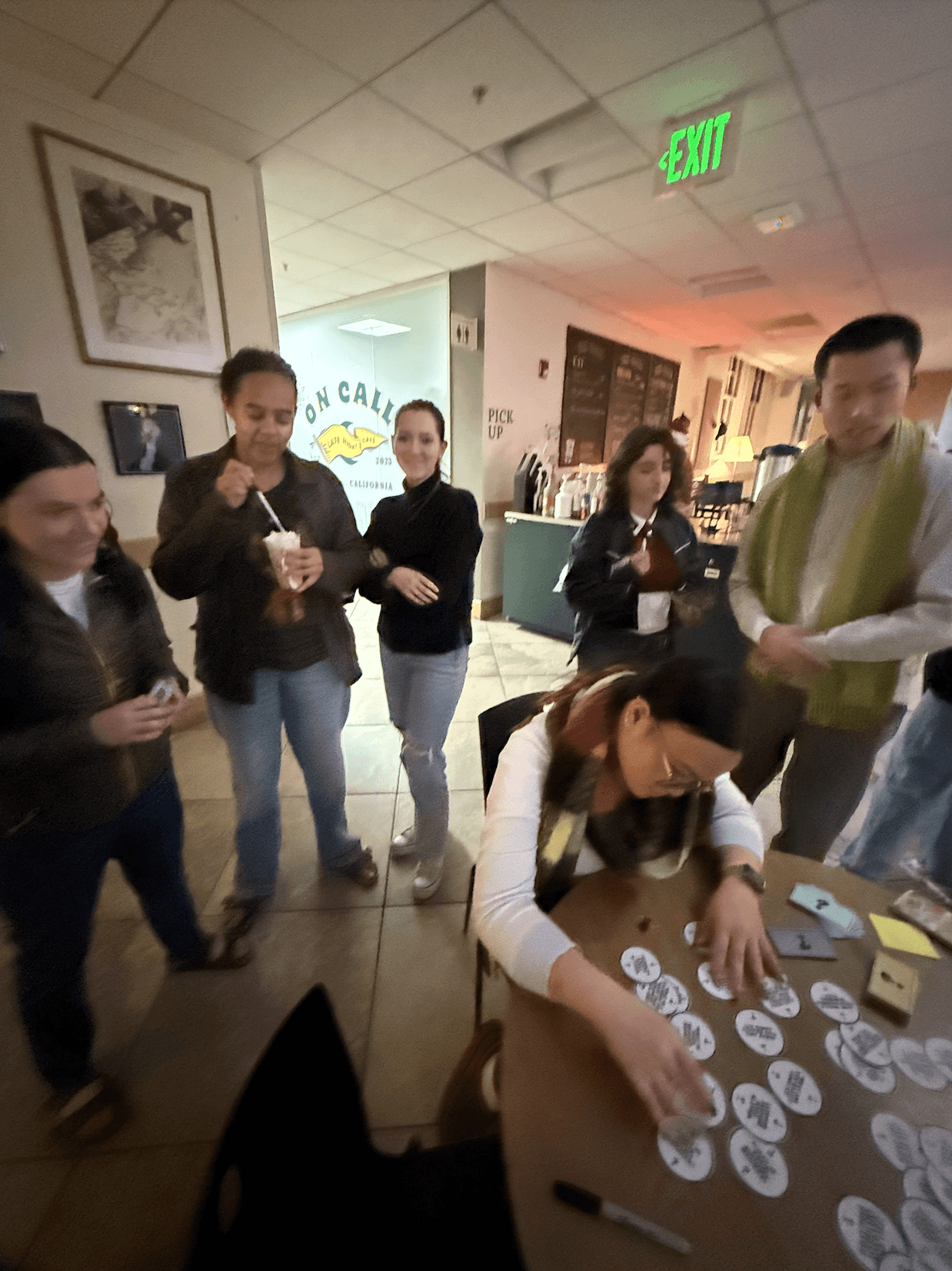
On our launch day, we created a cozy space (with a circular table!) to house “Ask Away!” along with all of our stickers. We also included a corkboard as our sign and a place for students to give feedback or record insights and thoughts from their conversations. We took note of what people would tell us, and we also had a Google Form where participants could reflect on how their connection with their conversation partner changed before and after their experience at the Conversation Corner! From the feedback form completed by 20 participants, each rated their closeness to their conversation group on a scale from 1 to 10 before and after their conversation. On average, the participants felt closer to the person they spoke to by about 2. However, we saw more dramatic increases among those who felt they barely knew their conversation partners (in the 1-3 range), with these participants often reporting a 5-6-level increase. In contrast, most people who began in the 7-9 range increased their closeness by only about 1, but still showed an increase!