A UX research project into the systems and products that Stanford’s Office of Sustainability has implemented to increase students’ rates of composting.
Overview
Despite over a decade of implementing services and systems to increase composting rates, waste audits show that 30% of the landfill on campus consists of materials that can be composted.
Problem Statement
The project was to identify a point that had yet to be addressed by the Office of Sustainability and, briefly (in two hours), prototype a product or plan a system that leverages that insight.
Brief
Role:
UX Researcher
Lead Designer
Project Length: Two weeks
Methods: User Interviews, Surveys, Research Synthesis, Wireframing
Tools:
Figma, Adobe Illustrator
Team Members: Solo-Project
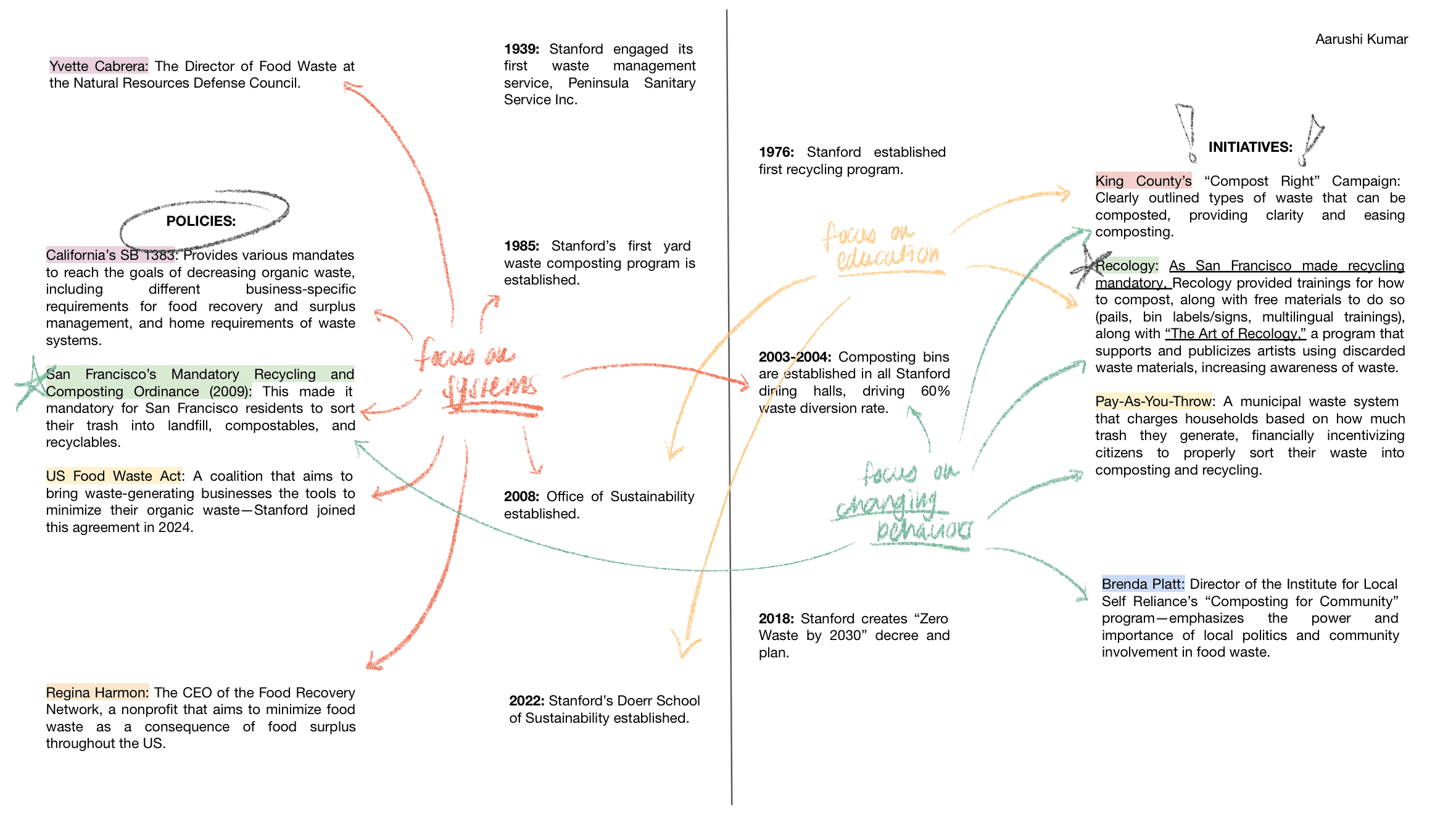
I began by researching the history of composting at Stanford and nationwide. I looked into successful and unsuccessful composting initiatives, compost-related policies at Stanford and at the government level, influential residents who’ve impacted composting, and a brief timeline of composting at Stanford.
However, the situations in which these initiatives were implemented were often in conditions quite different from a college campus—San Francisco’s incredibly successful composting ventures of the 90s, for example, have little impact on the direction of Stanford’s pursuit, as they are managing an entire city, not a college campus. They often had to consider far larger economic and political factors that the Office of Sustainability cannot control. Thus, I had to streamline my focus to Stanford, alone.
To understand the current state of composting at Stanford, I examined recent waste audits and surveys conducted by the Office of Sustainability. I found one key point: students consistently knew what could and could not be composted. This is likely in part due to a waste management education course that the Office of Sustainability requires students to complete before beginning their freshman year. However, despite this knowledge, many students continue to sort their waste improperly, as evidenced by the waste audits. Now, the new question was: why aren’t students composting if they know how?
A visualization of selected pieces of background information.
Background Research
Exploration & Discovery
To answer this question, I turned to interviews, as they allowed me to more deeply interrogate this aspect of student composting in a way surveys could not.
I merged my quantitative research with the qualitative interviews to come to three main insights:
I decided to focus on the final insight, as it had yet to be addressed in the Office of Sustainability’s audits and implementation.
Interviews
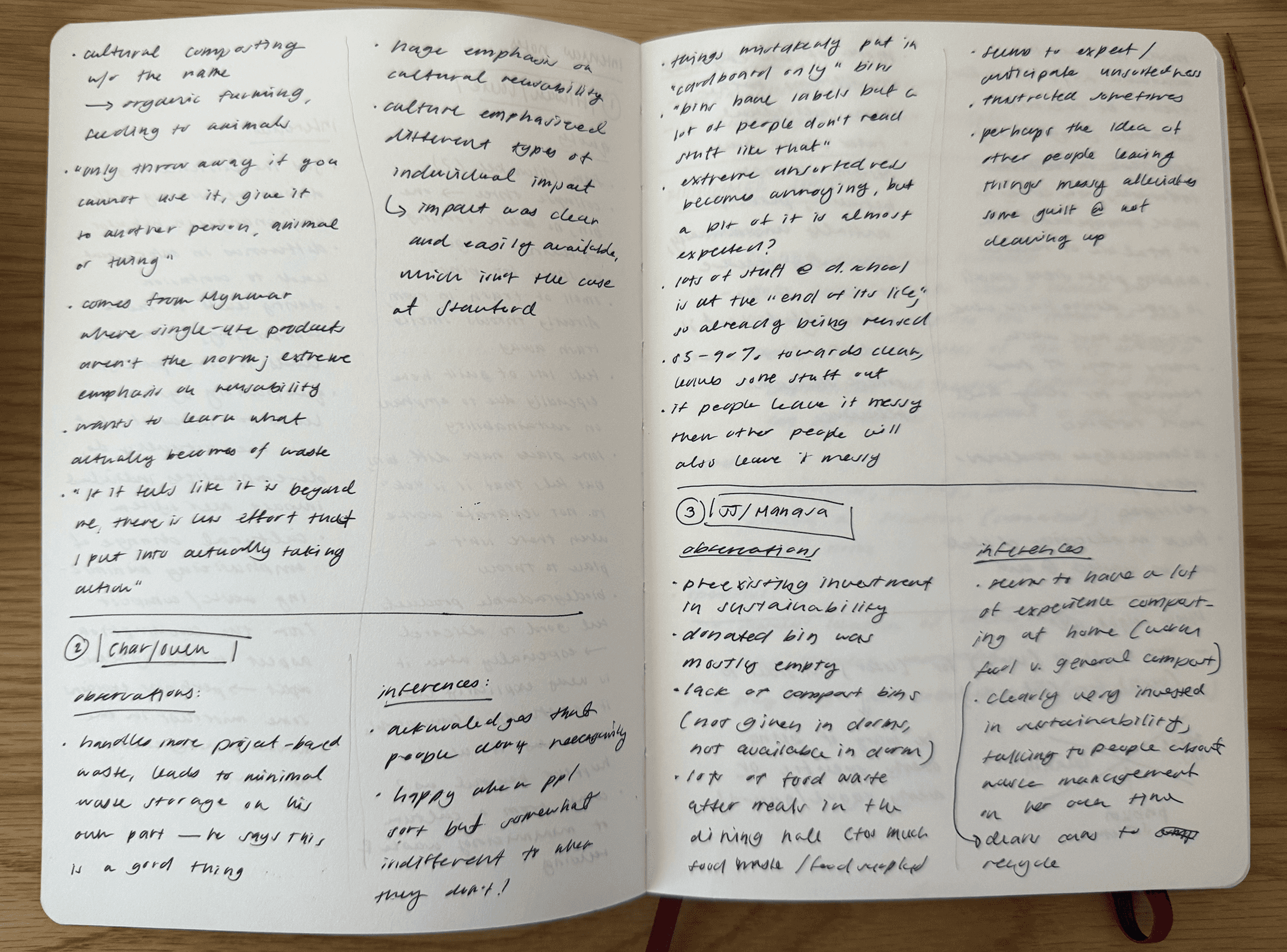
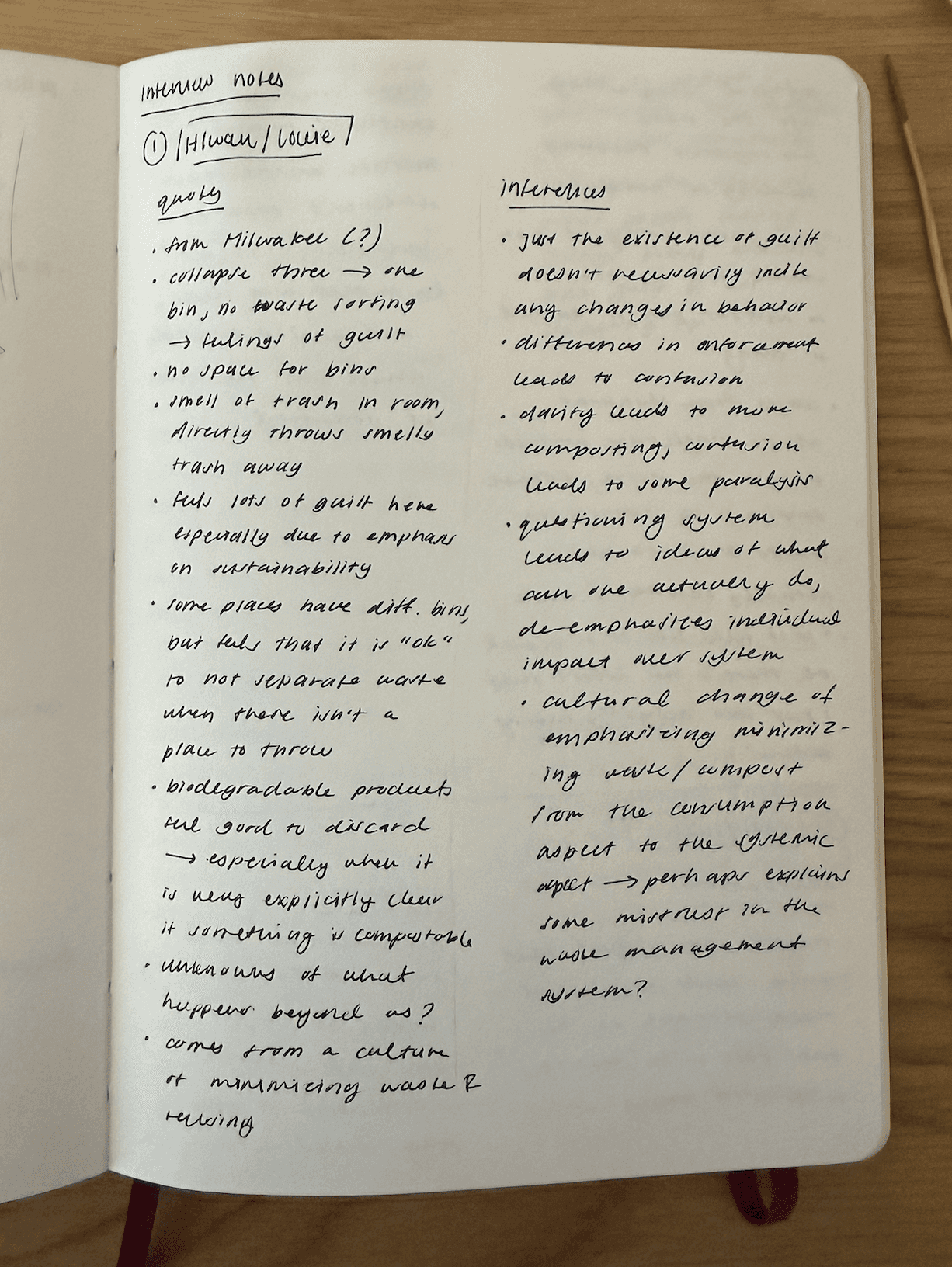
Approximately 24% of the discarded waste in the landfill is compostable food scraps, which doesn’t even cover the amount of food scraps we produce in our properly sorted compost. Alternatively, any cultures outside the United States emphasize minimizing food waste in the first place rather than properly sorting waste. Perhaps intervening in this aspect by reducing the amount of food that even needs to be appropriately sorted can decrease the amount of compostable food scraps discarded in landfills.
#1
According to Doerr, when compost bins were introduced in all the dining halls in 2004, Stanford’s diversion rate of compostable items from landfills increased to about 50%. More recently, students have noted that a hindrance to properly sorting their waste is whether the available waste bins are full (if they are, they will knowingly incorrectly sort their waste due to the limited options), or even if non-landfill bins are present. Therefore, the consistent availability of compost and recycling bins appears to directly influence students’ waste management by making it more convenient.
#2
Multiple students report that the presence of others watching them discard items efficiently prompts behavioral changes in composting: if they are with others who value proper waste management, they will compost, but if they are alone, they may not. Similarly, students report feeling guilty when they do not compost in environments that value it, such as Stanford. Therefore, the social behaviors of students and the perception of others play a significant role in the decision-making process surrounding waste management, with a greater perception from those who value compost seemingly leading to more composting among students.
#3
As I previously mentioned, the focus of this project was the research and synthesis, which were compiled into a report submitted to the Office of Sustainability. Thus, we were only instructed to ideate, not prototype. I am currently working on a prototype on my own, however, in class I ideated the following three solutions:
Ideation
Design
An inter-dorm competition in which a designated RA tracks each dorm's compost. The highest compost-to-landfill ratio each quarter will get a reward—a sponsored event or field trip, perhaps. Optionally, each resident's contributions to this statistic could be publicly displayed on a dorm chart.
#1
An app that would act as a social and material reward system. A student would be able to post their composting instances—an image of them throwing away their compost in a dining hall, or an image of them discarding a bag into the larger compost bin from their dorms—and receive social recognition from their friends, along with points which they could then exchange for dining dollars or gifts at student-run cafes and organizations on campus.
#2
Each dorm room at Stanford would be assigned a designated accountability pair (another room within the dorm). At the end of each quarter, students would be required to meet with their accountability partner and report on their waste management habits in their dorm. This would be a similar requirement to the annual dorm “roommate agreement” forms, with evidence of the accountability pair’s discussion being sent to the RAs.
#3
I am currently working on prototyping a high-fidelity version of the second idea.
Design (In Progress)
COM-POST
Increasing students’ composting rates through leveraging social and cultural influence.